• About
  • Coaching & Consulting
  • Success Stories
  • Subscribe
Healing Gourmet
  • Health
  • Diets
  • Recipes
  • Cookbooks
  • Meal Plans
  • Quiz
  • Search our library of health articles, recipes, therapeutic diets and more!

Gut Health Can a Low FODMAP Diet Ease Your Digestive Distress?
Can a Low FODMAP Diet Ease Your Digestive Distress?

Gut Health Low FODMAP Diet

Can a Low FODMAP Diet Ease Your Digestive Distress?

Kelley Herring

Can a Low FODMAP Diet Ease Your Digestive Distress?

Onions, garlic, apples, asparagus, sweet potatoes, Brussels sprouts…

These colorful fruits and vegetables would appear to be the foundation of a healthy diet. But is it possible that they could also cause digestive distress and even disease for some people?

The answer may surprise you.

According to recent research, the foods listed above (among many others) may contribute to painful and embarrassing “functional gut disorders” including bloating, irritable bowel syndrome (IBS) and diarrhea. And the reason why is because of compounds called FODMAPs, an acronym for Fermentable, Oligo-, Di- and Mono-saccharides and Polyols.

What are FODMAPS?

This group of compounds is found in a wide variety of foods, ranging from berries to buttermilk. Each one can have a distinct effects on the digestive system.

Let’s take a look:

Fermentable:

Carbohydrates that are fermentable are those that rely on gut bacteria (rather than digestive enzymes) to break down. As these carbohydrates ferment in the digestive tract, they produce a food source for the bacteria that reside in our digestive system. For many people, fermentable carbs are a good thing. They can boost digestive health and increase the number of beneficial bacteria. But for some people, the results are gas and bloating and an overgrowth of harmful gut bacteria.

Oligosaccharides:

These short-chain carbs include fructans (chains of fructose with a glucose molecule) and galactans (chains of galactose with a fructose molecule). For many who suffer from digestive distress, these compounds are poorly absorbed. This can cause an overgrowth of bacteria in the small intestine (called small intestinal bacterial overgrowth or SIBO).

Disaccharides:

Two sugar molecules bound together, with the most common being lactose (milk sugar). Many people have low levels of lactase – the enzyme that breaks down lactose – causing malabsorption when lactose-containing foods are consumed.

Monosaccharides:

A single sugar molecule. Fructose (or fruit sugar) is the often most problematic monosaccharide and contributes to gas and bloating for those with FODMAPS issues.

Polyols:

Also called sugar alcohols, polyols occur naturally in a wide variety of foods – from mushrooms and snow peas to cherries and apples. Polyols are also found in low-calorie sweeteners including sorbitol, mannitol, maltitol, xylitol and isomalt. In excess, these substances can have a laxative affect as they are poorly absorbed in the intestine.

Can a Low FODMAP Diet Reduce Gut Issues?

For many people, reducing foods that contain FODMAPS can provide significant digestive relief or cessation of symptoms.

In fact, according to a study published in the Journal of Gastroenterology and Hepatology, reducing FODMAPS reduced symptoms in approximately 75% of patients with functional gut disorders.

But not all FODMAPS are created equal when it comes to their impact on your health.

For example, you may react poorly to fructose, but have no problems with fermentable carbohydrates.

Another important factor is the amount of FODMAPS consumed. Because these compounds are ubiquitous in the food supply it is almost impossible to avoid them entirely. But reducing the FODMAPS that you personally react to is the best way to reduce digestive distress from these compounds while still enjoying a diverse, nutrient-rich diet.

Take a look at the classes of FODMAPS and the foods in which they are found:
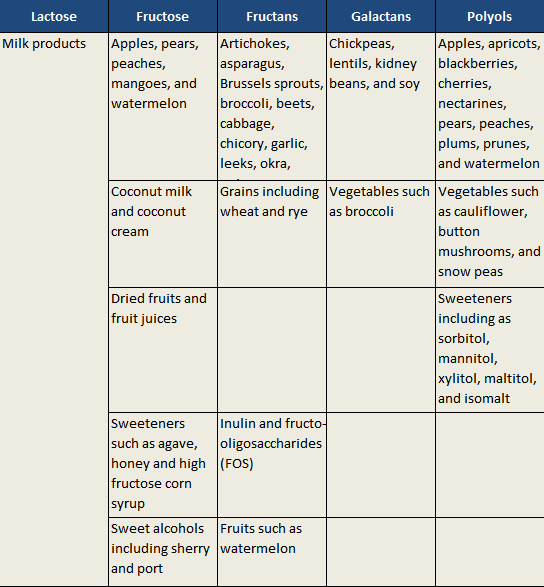
fodmap foods list

If you suffer from digestive issues, choosing an ancestral diet, rich in healthy fats and protein is a good first step. Grains, legumes and most dairy products can be problematic for the GI tract and for overall health, as well.

From there, a food journal can be beneficial in rooting out the offending FODMAPS. Pay close attention to how you feel after consuming FODMAP-rich foods to create your personalized healthy-gut diet.

Finally, eating a low FODMAP diet doesn’t have to be bland and boring. Here are a few quick and healthy meal ideas to get you started:

  • Grass-Fed Beef and Bok Choy Stir-Fry With Red Bell Peppers
  • Oven-Roasted Pastured Chicken with Organic Tomatoes and Wilted Spinach
  • Almond Flour Paleo Pancakes with Blueberries and Sugar-Free Pork Bacon or Breakfast Sausage
  • Grilled Heirloom Pork Chops with Sautéed Carrots and Butter Lettuce Salad
  • Bison-Stuffed Bell Peppers
Pin26
Share
Tweet
Share
Email
26 Shares

This post may contain affiliate links. Click here to read my affiliate policy.

Pin26
Share
Tweet
Share
Email
26 Shares
Previous Post
The Carnivore Diet: A Panacea for Autoimmune & Chronic Illness?
Next Post
The Fatty Secret to Preventing Heart Disease

References

  1. de Roest RH, Dobbs BR, Chapman BA, Batman B, O’Brien LA, Leeper JA, Hebblethwaite CR, Gearry RB. The low FODMAP diet improves gastrointestinal symptoms in patients with irritable bowel syndrome: a prospective study. Int J Clin Pract. 2013 Sep;67(9):895-903. (PubMed)
  2. Gibson PR, Shepherd SJ. Evidence-based dietary management of functional gastrointestinal symptoms: The FODMAP approach. J Gastroenterol Hepatol. 2010;25(2):252-258. (PubMed)
  3. Ringel Y, Williams RE, Kalilani L, Cook SF. Prevalence, characteristics, and impact of bloating symptoms in patients with irritable bowel syndrome. Clin Gastroenterol Hepatol. 2009;7(1) 68-72. (PubMed)
  4. Shepherd SJ, Parker FC, Muir JG, Gibson PR. Dietary triggers of abdominal symptoms in patients with irritable bowel syndrome: Randomized placebo-controlled evidence. Clin Gastroenterol Hepatol. 2008;6(7):765-771. (PubMed)
  5. Rumessen JJ, Gudmand-Høyer E. Absorption capacity of fructose in healthy adults. Comparison with sucrose and its constituent monosaccharides. Gut. 1986;27(6):1161-1168. (PubMed)
  6. Muir JG, Rose R, Rosella O, et al. Measurement of short-chain carbohydrates in common Australian vegetables and fruits by high-performance liquid chromatography (HPLC). J Agric Food Chem. 2009;57(2):554-565. (PubMed)
  7. Moshfegh AJ, Friday JE, Goldman JP, Ahuja JK. Presence of inulin and oligofructose in the diets of Americans. J Nutr. 1999;129(7 Suppl):1407S-1411S. (PubMed)

About The Author

Kelley Herring

Kelley Herring, founder of Healing Gourmet, is a natural nutrition enthusiast with a background in biochemistry. Her passion is educating on how foods promote health and protect against disease and creating simple and delicious recipes for vibrant health and enjoyment.

Related Articles

Image from a post with the title: The Brothfast – A Digestive Reset for Vibrant Health.

Beauty Food Gut Health

The Brothfast – A Digestive Reset for Vibrant Health
Image from a post with the title: A Low-Oxalate Diet for Autism.

Brain Health Gut Health

A Low-Oxalate Diet for Autism
Image from a post with the title: A Root Cause of  Restless Legs Syndrome (RLS).

Brain Health Gut Health

A Root Cause of Restless Legs Syndrome (RLS)

Leave a Reply Cancel reply

Your email address will not be published. Required fields are marked *

Click here to subscribe

Latest Articles

Image from a post with the title: CoQ10 Supplements… Eat Your Heart....
CoQ10 Supplements… Eat Your Heart...
Image from a post with the title: Decoding Tubers: Finding the Best....
Decoding Tubers: Finding the Best...
Image from a post with the title: The Great Meat Debate: Plant-Based....
The Great Meat Debate: Plant-Based...
Image from a post with the title: Eat THESE Foods to Program....
Eat THESE Foods to Program...
Image from a post with the title: Mend Your Metabolism for a....
Mend Your Metabolism for a...
Instant Pot Keto Dinners

Back to homepage.
Top 5 Categories
  • Keto Diet
  • Personalized Diet
  • Keto Recipes
  • Instant Pot Recipes
  • Meal Plans
Contact info

2614 Tamiami Trail North, Ste #219, Naples, FL 34103

info@healinggourmet.com

The information presented on this website is not intended as specific medical advice and is not a substitute for
professional medical treatment or diagnosis.

Copyright © 2019 Health-e Enterprises, LLC. “Healing Gourmet” is a registered trademark of Health-e Enterprises, LLC. All rights reserved. No reproduction, transmission or display is permitted without the written permissions of Health-e Enterprises, LLC

  • About
  • Contact
  • Privacy Policy
  • User Site Agreement
  • Affiliate Disclosure