

Sweet Potatoes vs Yams and White Potatoes: Which is Healthiest?
In the realm of culinary staples, few foods are as popular as potatoes, gracing dinner tables across the globe in various forms. Whether roasted, boiled, mashed, or fried, the humble potato is a versatile delight that has earned its place in countless recipes and hearts.
However, within the potato family, there lies a trinity of tubers—sweet potatoes, yams, and white potatoes—each with its unique characteristics, nutritional nuances, and culinary possibilities.
In this article, we’ll embark on a journey to demystify the nutritional secrets of these culinary classics, helping you understand the attributes – and potential drawbacks – of your favorite spuds.
Sweet Potatoes: A Symphony of Colors and Nutrients
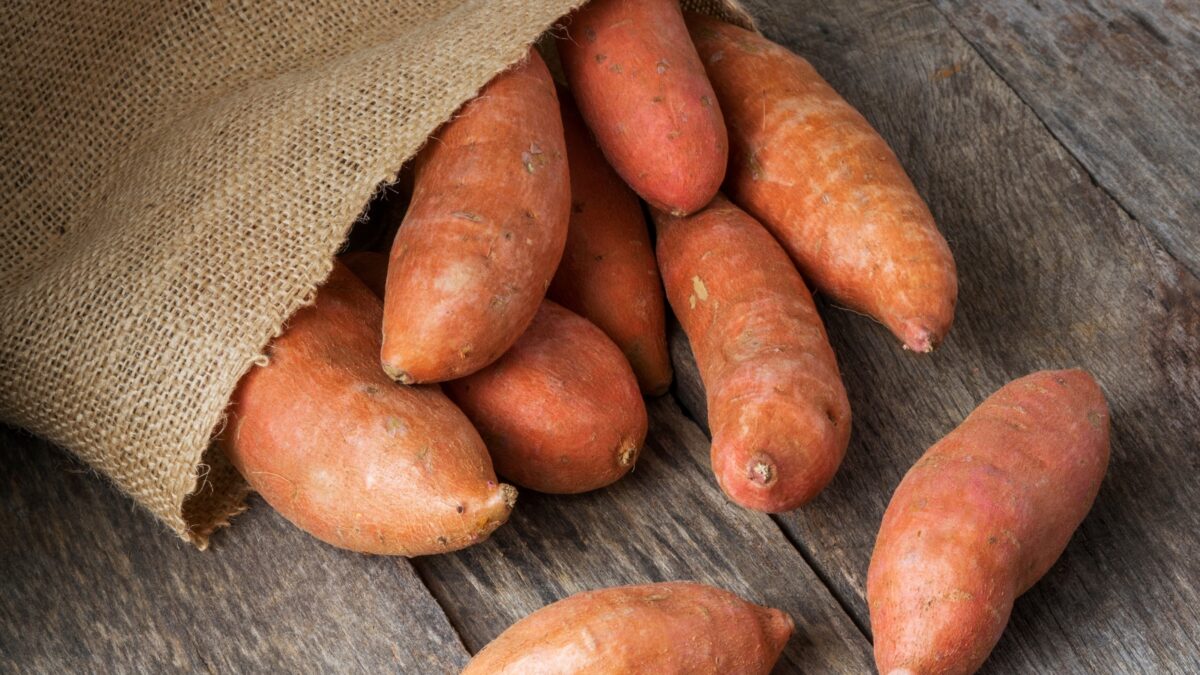
Originating from Central and South America, sweet potatoes make a dazzling addition to any meal with their vibrant hues of orange and red.[i]
Nutritionally, sweet potatoes are a rich source of beta-carotene, which the body converts into vitamin A. They also provide about 35-40% of the daily requirement for vitamin C, in addition to manganese, vitamin B6, potassium, copper, niacin, thiamine, and magnesium.[ii]
Sweet potatoes are valued for their blood sugar-regulating properties due to their high fiber content and antioxidant content. A study from Austria even demonstrated that diabetics who consumed sweet potatoes had lower blood sugar levels compared to a control group, likely due to the high fiber and antioxidant content.[iii]
Due to their blood sugar-regulating properties and antioxidant richness, sweet potatoes are a culinary gem that may help balance blood sugar, improve brain function and protection against chronic diseases.[iv]
Sweet potatoes are delicious baked, mashed, slow cooked, pressure cooked, or added to creamy soups, casseroles and stews. Because the carotenoid antioxidants in sweet potatoes are lipid-soluble, be sure to consume them with a healthy fat (like grass-fed butter or coconut oil) to maximize absorption.
Yams: Robust and Resilient
Hailing from Africa and Asia, yams stand as formidable tubers, often reaching lengths of up to 5 feet.
With a robust, bark-like exterior and a starchy interior, yams bring a distinct texture to the table. The inner flesh may vary in color from white and yellow to even purple or pinkish. Unlike sweet potatoes, yams are not known for their sweetness; they have a dry and starchy taste.
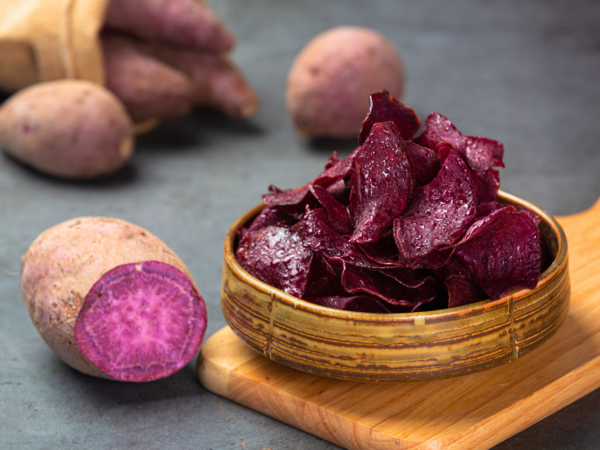
Purple yams, also known as ube, exhibit notable antioxidant properties attributed to the presence of anthocyanins. Anthocyanins are vibrant pigments that contribute to the purple color in these yams and are well-known antioxidants.[v]
In contrast to the culinary preparations of sweet potatoes, yams are typically boiled and mashed into a starchy paste known as “Fufu.”
Yam’s nutritional profile, while substantial, comes up short against the vibrant antioxidants found in sweet potatoes.
Unveiling the Confusion: Sweet Potatoes vs. Yams
In the United States, the terms “yams” and “sweet potatoes” are often used interchangeably, causing confusion among grocery goers.
This mix-up has historical roots, as African slaves referred to American sweet potatoes as “nyami” or “yam” because of their resemblance to the African yam.
To distinguish the newly introduced dark-skinned sweet potatoes from the original variety, they were labeled as “yams.” However, it is important to note that these “garnet yams” found in grocery stores are, in fact, sweet potatoes.
White Potatoes: A Familiar Face in the Nightshade Family
Commonly found in russet, red, and purple varieties, white potatoes belong to the Solanaceae family, sharing kinship with tomatoes and peppers.
White potatoes are often viewed as “empty carbs” due to their lack the vitamin A and antioxidant levels present in sweet potatoes. However, they do contribute essential nutrients like vitamin C, folate, and potassium, as well as a special kind of starch called resistant starch.
Resistant starch is a type of starch that is not fully broken down and absorbed in the small intestine, reaching the colon intact where it can have various health benefits. Cooking and cooling certain starchy foods, including potatoes, can increase the content of resistant starch, providing additional health advantages. Here’s a short list of the benefits of resistant starch in potatoes:
- Improved Blood Sugar Control: Resistant starch has long been associated with improved insulin sensitivity and better blood sugar control. This can be particularly beneficial for individuals with diabetes or those at risk of developing diabetes.[vi]
- Enhanced Satiety: Resistant starch contributes to increased feelings of fullness and satiety, potentially aiding in weight management, reducing cravings and promoting healthier eating habits.[vii]
- Gut Health: The fermentation of resistant starch in the colon produces short-chain fatty acids, which can have positive effects on gut health. These fatty acids are a preferred energy source for the cells lining the colon and contribute to a healthier gut environment.[viii]
Glycemic Impact: Decoding Blood Sugar Dynamics
Understanding the glycemic impact of these tubers is crucial for those mindful of blood sugar levels. And if you are a health advocate, you know that your blood sugar is one of the most important factors for your longevity and disease prevention.
Sweet potatoes boast a medium-to-high glycemic index (GI) of 60.
Yams, with a lower GI of approximately 50, provide a gentler impact on blood sugar.
White potatoes, scoring the highest at 75, may lead to a more significant spike in blood sugar when consumed in equal amounts. However, as you just learned, cooking and cooling potatoes (Think: Creamy loaded potato soup made from leftover potatoes), is a proven method for reducing the glycemic impact of these veggies. [ix]
It’s important to note that individual responses to the glycemic impact can vary, and factors such as the type of potato, cooking method, and overall meal composition will also influence blood sugar levels. Top of Form

Concerning Compounds: Exploring FODMAPs, Oxalates, and Alkaloids
Diving deeper into the nutritional landscape of tubers, it’s essential to consider specific compounds that may pose issues for certain sensitive people.
FODMAPs, present in varying degrees in sweet potatoes, yams, and white potatoes, may cause digestive disturbances in individuals with sensitivities or gut imbalances, such as small intestine bacterial overgrowth (SIBO).[x] [xi]
Oxalates, found in sweet potatoes and yams, can affect those prone to kidney stones.[xii] Oxalates may also be problematic in those with autism, potentially crossing the blood-brain barrier and causing disturbances in the central nervous system.[xiii]
Alkaloids, concentrated in white potatoes, may increase inflammation in certain people, especially in those who struggle with joint inflammation and arthritis.[xiv]
Crafting a Balanced Plate: A Culinary Adventure Awaits
Understanding the glycemic impact, navigating specific compounds, and appreciating the culinary possibilities of tubers allow us to craft a balanced plate that not only satisfies our taste buds, but promotes personalized well-being, to boot.
References (1)
[i] Goyal A, et al. Flavonoids: an overview. J Nutr Sci. 2012;1:e24. (PubMed)
[ii] Woolfe JA. Sweet potato: an untapped food resource. Cambridge University Press; 1992.
[iii] Raben A, Tagliabue A, Christensen NJ, et al. Resistant starch: the effect on postprandial glycemia, hormonal response, and satiety. Am J Clin Nutr. 1994;60(4):544-551. doi:10.1093/ajcn/60.4.544 (PubMed)
[iv] Bohn T, Desmarchelier C, Dragstedet LO, et al. Host-related factors explaining interindividual variability of carotenoid bioavailability and tissue concentrations in humans. Mol Nutr Food Res. 2007;51(10):1300-1309.
[v] Jayaprakasha GK, Singh RP, Sakariah KK. Antioxidant activity of grape seed (Vitis vinifera) extracts on peroxidation models in vitro. Food Chem. 2001;73(3):285-290. doi:10.1016/s0308-8146(00)00298-3 (Link)
[vi] Nilsson AC, Ostman EM, Knudsen KE, Holst JJ, Bjorck IM. A cereal-based evening meal rich in indigestible carbohydrates increases plasma butyrate the next morning. The Journal of Nutrition. 2010;140(11):1932-1936. DOI: 10.3945/jn.110.124701 (PubMed)
[vii] Higgins JA. Resistant starch and energy balance: impact on weight loss and maintenance. Critical Reviews in Food Science and Nutrition. 2014;54(9):1158-1166. DOI: 10.1080/10408398.2011.629352 (PubMed)
[viii] Topping DL, Clifton PM. Short-chain fatty acids and human colonic function: roles of resistant starch and nonstarch polysaccharides. Physiological Reviews. 2001;81(3):1031-1064. DOI: 10.1152/physrev.2001.81.3.1031 (PubMed)
[ix] Englyst HN, Kingman SM, Cummings JH. Classification and measurement of nutritionally important starch fractions. European Journal of Clinical Nutrition. 1992;46 Suppl 2:S33-50. PMID: 1446895 (PubMed)
[x] Murray K, Wilkinson-Smith V, Hoad C, et al. Differential Effects of FODMAPs (Fermentable Oligo-, Di-, Mono-Saccharides and Polyols) on Small and Large Intestinal Contents in Healthy Subjects Shown by MRI. Am J Gastroenterol. 2014;109(1):110-119. doi:10.1038/ajg.2013.386 (PubMed)
[xi] Więcek M, Panufnik P, Kaniewska M, Lewandowski K, Rydzewska G. Low-FODMAP Diet for the Management of Irritable Bowel Syndrome in Remission of IBD. Nutrients. 2022 Oct 29;14(21):4562. doi: 10.3390/nu14214562. PMID: 36364824; PMCID: PMC9658010. (PubMed)
[xii] Holmes RP, Knight J, Assimos DG. Lowering urinary oxalate excretion to decrease calcium oxalate stone disease. Urolithiasis. 2016;44(1):27-32. doi:10.1007/s00240-015-0788-8 (PubMed)
[xiii] Konstantynowicz J, Porowski T, Zoch-Zwierz W, et al. A potential pathogenic role of oxalate in autism. Eur J Paediatr Neurol. 2012 Sep;16(5):485-91. doi: 10.1016/j.ejpn.2011.08.004. Epub 2011 Sep 10. PMID: 21911305. (PubMed)
[xiv] Friedman M. Potato glycoalkaloids and metabolites: roles in the plant and in the diet. J Agric Food Chem. 2006;54(23):8655-8681. doi:10.1021/jf061471t (PubMed)

Leave a Reply