
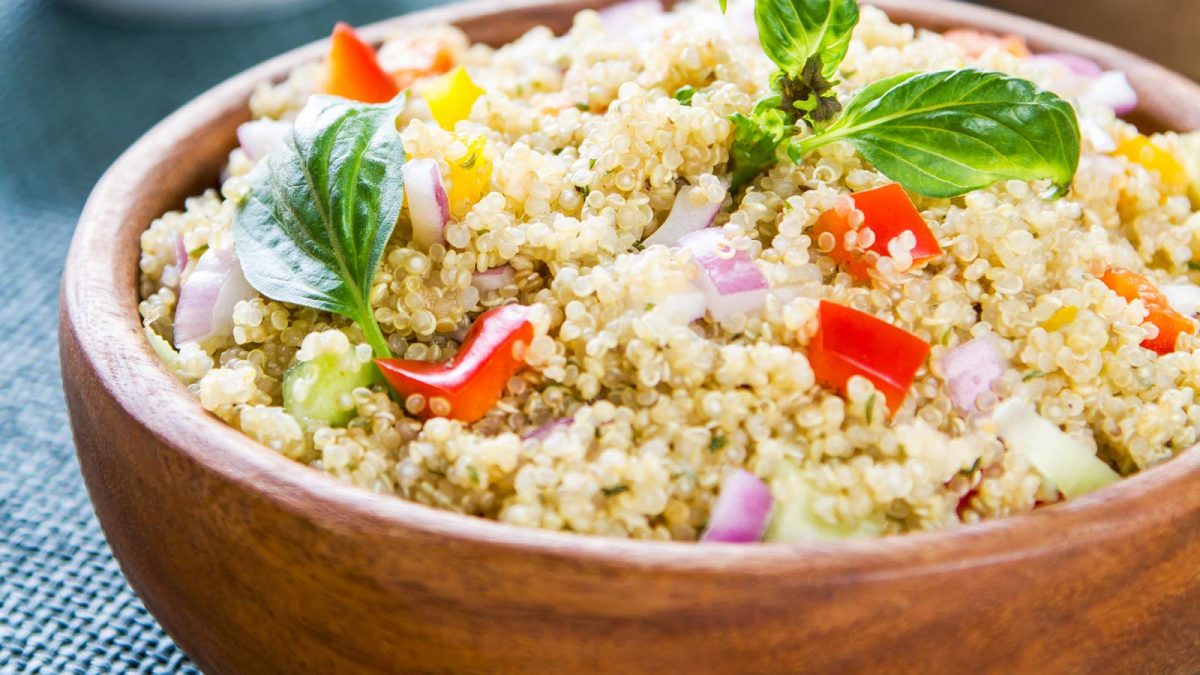

Is Quinoa Healthy? (Gluten, Leaky Gut + More)
If you’ve recently adopted a gluten free diet, you may be experimenting with adding foods like healthy quinoa, buckwheat and amaranth to your diet.
Because these foods have many of the same culinary characteristics of wheat, they can easily be used in recipes for pancakes, muffins, cakes and other baked goods. They even have a similar taste and texture of traditional grain-based products.
However, technically and botanically speaking, they aren’t grains at all. They are seeds and belong to a different botanical class, which is why they are often called, pseudograins.
Of these “false” grains, quinoa has gained the most popularity. In fact, quinoa has been referred to as the “Supergrain of the Future.” The Food & Agriculture Organization of the United Nations even declared that 2013 was the “International Year of Quinoa”.
Quinoa is a relative of spinach, beets and chard. And considering those family ties, it would seem that quinoa deserves its recent recognition. But is quinoa really the superfood it is cracked up to be?
Is Quinoa Healthy: Ancient Supergrain or Modern Superscam?
Providing all nine essential amino acids, a rich source of fiber, magnesium, iron and riboflavin, quinoa also has a rich nutritional profile.
And while some people tolerate it better than gluten-containing grains like wheat, there is a dark side of quinoa and other pseudograins, of which you might not be aware. In fact, many people report adverse responses to quinoa that can range from mild digestive disturbance, to prolonged headaches and fatigue… to full-blown anaphylactic reactions.
And one reason is compounds in these foods called saponins.
Quinoa: Gluten Cross-Reactivity and Leaky Gut
Saponins are sap-like compounds that coat the exterior of quinoa. Like their name suggests, saponins are soap-like molecules that act as a defense mechanism for the plant.
When consumed, saponins can cause microscopic holes in the sensitive lining of the gastrointestinal tract. Over time, this can lead to a “leaky gut”, allowing the contents of the gut to leak into the blood stream where they can trigger autoimmune diseases and systemic inflammation.
In fact, saponins are so irritating to the immune system that they are used as “adjuvants” in vaccines to stimulate the body’s immune response.
And that’s not all. Research published in the American Journal of Clinical Nutrition found that quinoa can also cross-react with gluten, due to compounds called prolamins.
That means if you’ve gone gluten-free, but are still eating quinoa, you may continue to experience symptoms until you completely eliminate quinoa from your diet.
Rinsing, Soaking and Fermenting Quinoa: Does It Help?
If you commonly eat quinoa, you probably know that rinsing it is an essential step in its preparation. This is intended to remove the saponins. However, studies show that rinsing is not enough.
Similar to grains, quinoa also contains phytic acid. This is an anti-nutrient, which actively binds to important minerals and makes them unavailable to the body.
According to Weston A. Price foundation, quinoa should not only be rinsed, but also soaked, germinated and fermented prior to cooking to eliminate the majority of the phytic acid.
Take a look:
- Cooking quinoa without rinsing removed 15-20% of phytic acid
- Soaking 12-14 hours, then cooking removes 60-77% of phytic acid
- Fermenting with whey for 16-18 hours, then cooking eliminates 82-88% of phytic acid
- Soaking (12-14 hours), germinating (30 hours), fermenting (16-18 hours), then cooking removes 97-98% of phytic acid
A Nutritional Staple or Unnecessary Filler Food?
While quinoa’s nutritional profile may “look good on paper”, there are several reasons to avoid it – namely saponins, prolamins and phytic acid – not to mention unnecessary carbohydrates.
Get your complete protein source from grass-fed beef, wild fish, pastured poultry, pork and eggs, with an assortment of mineral-rich leafy greens, colorful seasonal veggies and low sugar, antioxidant-rich fruits like organic berries and cherries.
You’ll nourish your body with all of the nutrients it needs, while avoiding the potentially harmful immune-stimulating substances that were never a concern for our ancestors.

Kelley, thanks very much for the information on Quinoa. It helps me a lot. I like you to know that I am enjoying the banana bread I got from from your Keto bread book. It is awesome. Question, could I use buckwheat to make some of the breads in you break book? I like to tinker mixing different flours.
Thanks,
Hello Fabio!
Thank you for your kind message and for supporting our work.
You can absolutely tinker with buckwheat in the recipes. It is a more dense flour, so I would suggest replacing some of the almond flour with it. Also, keep in mind, it is not low in carbohydrates, so the nutritional composition will change.
Please let me know how it goes!
Best,
Kelley
Important included message about the dangerous negatives of Quinoa